
How to Search Criminal Dockets
No single portal covers every Whitfield County criminal docket. The county's free Magistrate search works for that court alone. Its case-number route accepts the CRIMINAL type plus current divisions like MM for misdemeanor citation. Felony matters in Superior Court run through the Clerk of Superior Court and Georgia E-Access to PeachCourt. That route requires an account. Probate, the municipal courts, and Juvenile each keep separate channels. Juvenile access is tightly limited.
Gather a case number, an exact party name, and the court named on the notice before you search. Magistrate numbers follow a pattern like MGMMYYYY######. Don't force an outdated code into the live form. The dropdown choices on the current portal control what the search accepts.
- Identify the court from the notice, charge level, or case prefix.
- Use the Magistrate portal only for a Magistrate matter, then choose CRIMINAL and the live division.
- For a Superior matter, check Georgia E-Access and the PeachCourt account route.
- Read the header, offenses, proceedings, and close status as separate fields.
- Call or visit the responsible clerk when an entry or document is absent.
Whitfield Felony Dockets Start Superior
Felonies in Whitfield County belong to Superior Court of the Conasauga Judicial Circuit. That court holds exclusive constitutional authority over them. For file and docket questions, call the criminal division of the Clerk of Superior Court at 706-275-7490. The general line is 706-275-7450. The office sits at 205 N Selvidge Street in Dalton. The official Superior Court page also points visitors toward calendar information.
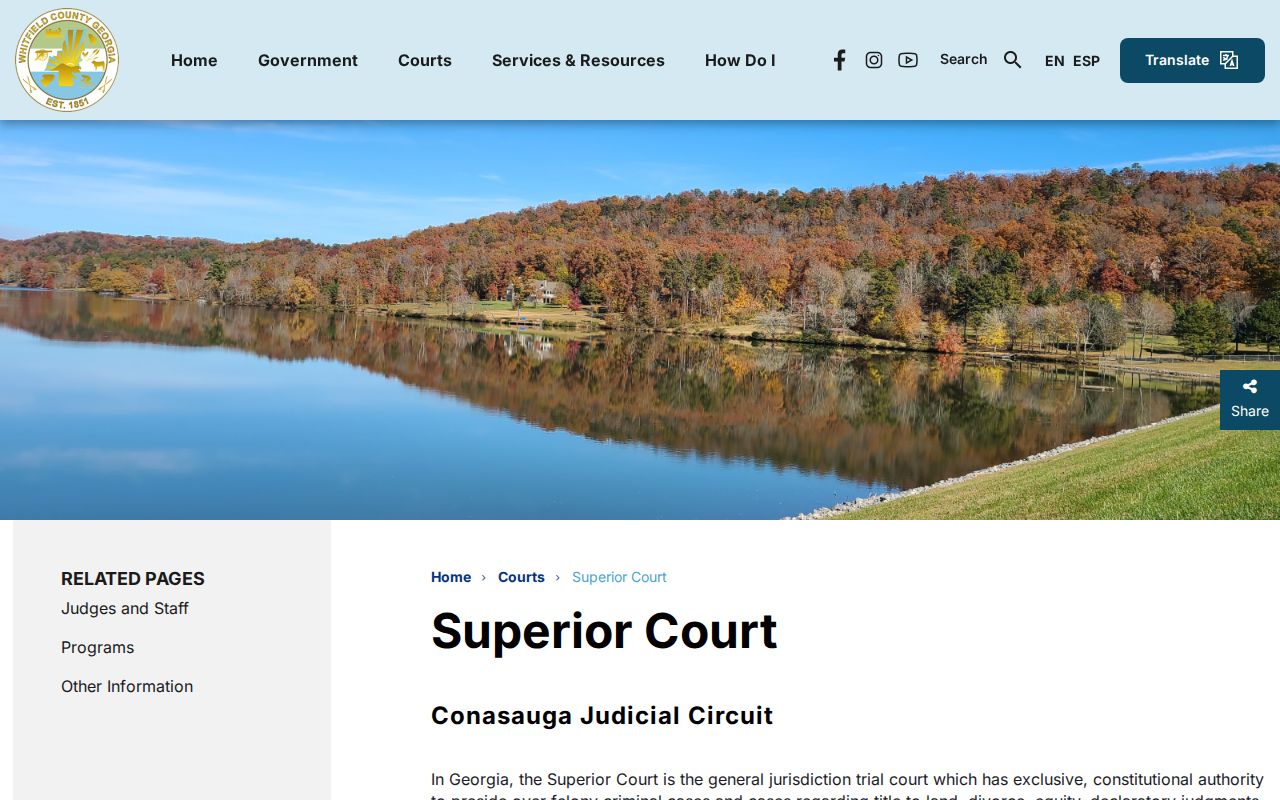
The court page helps you find the right institution. It won't turn every filing into a free document image. A warrant or preliminary event may surface first in a lower court, even when the later felony docket sits with the Superior Clerk.
What a Criminal Docket Shows
The live Magistrate Case Overview splits its facts into a header plus four tabs. That layout keeps an allegation separate from later events. It also shows why no single row tells the whole story of a Whitfield County docket.
| Case header | Case number, active status, judge, filing date and time, close date, and remarks. |
|---|---|
| Parties | Party name and code, active flag, garnishee field, first-order field, and convicted-felon system field. |
| Offenses | Offense, statute, reduced statute and description, GCIC count, count, and party name. |
| Proceedings | Code, description, filing date, party, offense, comments, and View control. |
| Associated parties | Associated-party name and code, linked party, and active status. |
A View control may require you to sign in first. Seeing a proceeding row does not promise a free image. And "Active" describes the case status, never guilt.
Whitfield Proceedings Are Not Dispositions
A hearing entry proves the court set or recorded an event. It says nothing about how the judge ruled. In Superior Court, labels like CJ, GJ, arraignment, criminal jury, and pretrial mark setting blocks, not outcomes. Read the filing date and description first. Then hunt for a separate order, disposition, sentence, judgment, or close date on the docket.
Common mistake: A scheduled hearing is not a conviction, and a blank close date does not erase the event history already entered.
Offense and statute fields describe an allegation or a classification. A reduced-statute field may reflect a later classification. But the docket won't necessarily explain why. GCIC Count is just a data field, not a conviction count. When you need a formal answer, request the underlying order.
Stages on a Criminal Docket
A Whitfield County criminal docket might open with a filing, a warrant, or a lower-court event. Arraignment handles the charge and the plea process. Pretrial entries bring motions, settings, and continuances, and a plea or trial can then produce a judgment, sentence, or dismissal. The event text and the underlying order always control.
Docket flow: Filing › Arraignment › Pretrial › Plea or Trial › Disposition › Sentencing
Cases don't always follow the steps in that order. A reset simply moves a setting; it does not dismiss a charge. Confirm the next date with the court rather than trusting an old notice.
Whitfield Criminal Docket Clerk Map
Which clerk you need depends entirely on the court, and that local split is the key to a sound search. The Whitfield Clerk of Superior Court page lays out Superior clerk services and its separate divisions.
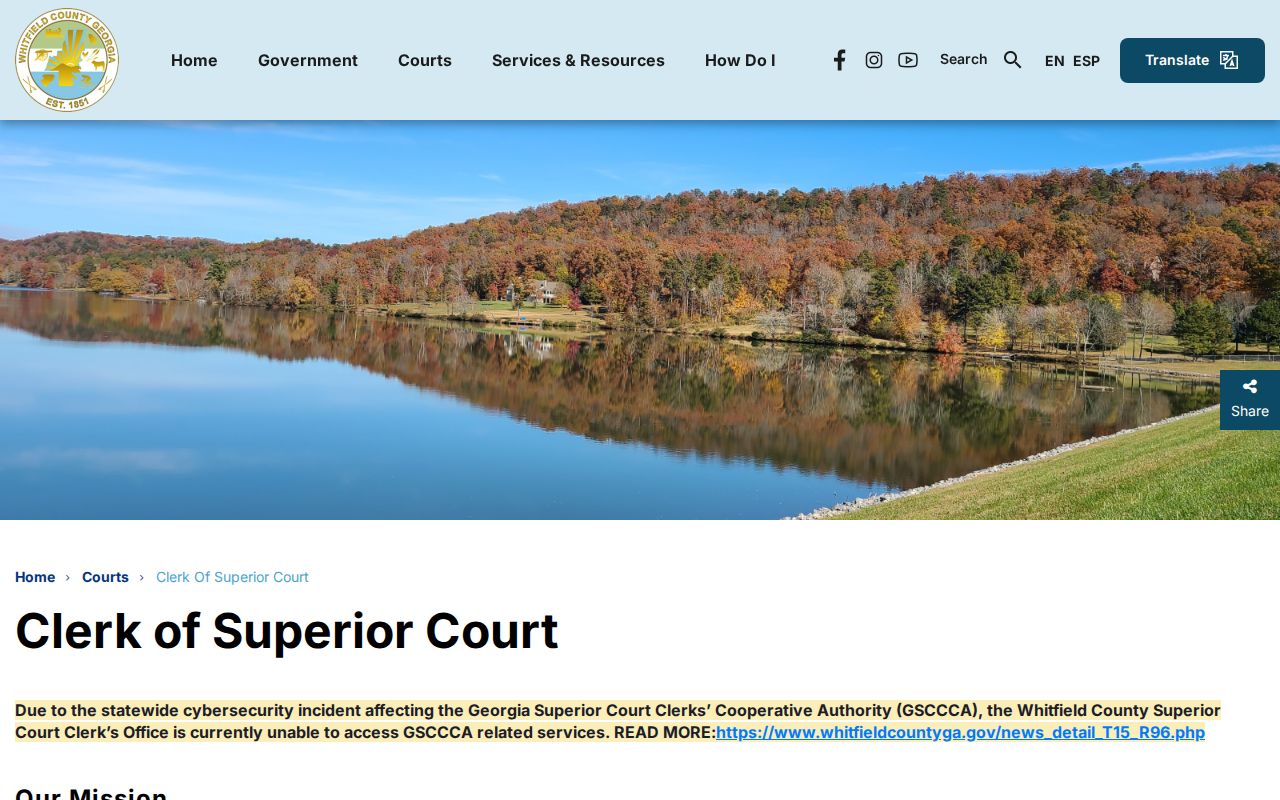
Start a Superior request with that clerk page. Lower courts answer for their own Whitfield County criminal dockets.
| Court | Criminal role | Contact |
|---|---|---|
| Superior | Felonies and related general-jurisdiction matters | 205 N Selvidge Street; 706-275-7490 |
| Magistrate | Warrants, preliminary functions, misdemeanor citations, probation divisions | Suite E; 706-278-5052 |
| Probate | Specified misdemeanor, traffic, game, and fish matters | Suite G; 706-275-7400 |
| Juvenile | Delinquency and related matters with limited public access | 706-278-6558 |
Which Court Holds Criminal Dockets
A Whitfield felony docket belongs to Superior Court. Magistrate Court handles the preliminary, warrant, and minor criminal functions shown in its system. The municipal courts in Dalton, Cohutta, Tunnel Hill, and Varnell hear traffic, ordinance, and specified misdemeanor or preliminary matters inside city limits. Varnell expressly routes felonies to Whitfield Superior. Probate holds limited criminal and traffic jurisdiction.
Whitfield County lists no separate State Court. So don't send a search to an assumed one. Federal cases sit outside the county system entirely. Whitfield falls in the Rome division of the Northern District of Georgia, and federal dockets run through PACER. Court class and location decide where a record lives.
Whitfield Criminal Codes Can Change
Older county instructions describe WM warrant-misdemeanor and WF warrant-felony numbering. The live Magistrate portal now offers divisions like CH for commitment hearings, MM for misdemeanor citation, and PR for probation. Treat the current dropdown as the working source. An old PDF may decode an old number, but it can't replace today's court choices.
If a number fails, copy it exactly from the notice and retry the current case-number route. Test party spelling and status filters too. A missing result might mean the wrong court, an old code, a portal boundary, or restricted access. It does not prove no case exists.
Whitfield Criminal Docket Access Channels
The web is not the only way in. Magistrate cases run through the free county portal. Whitfield Superior cases go through Georgia E-Access to PeachCourt. A PeachCourt account wall is not a full free public docket. Treat it as one channel among several. You can also call or visit the Superior criminal division, Magistrate, Probate, Juvenile, or the right city clerk. Any of them can help with a Whitfield County court docket.
A written request works too. Keep it narrow: ask the clerk for an existing docket, order, or date range. The county form lists P.O. Box 248, Dalton, GA 30722, phone 706-275-7507, and fax 706-275-7540. The Superior Clerk can confirm whether that general form fits a Superior criminal request. For mail, name the court, case number, record, and date range. Do not ask an agency to build a new criminal-history compilation.
Two other tools serve different jobs. The statewide Criminal Case Data Exchange dashboard gives aggregate analytics, not person-specific lookup. It refreshes every 60 days. It reports disposition transmissions by county and court class. PACER stays separate and covers federal cases only.
Public Access and Sealed Criminal Dockets
Georgia law leans toward access. Yet a public Whitfield County criminal docket may still omit protected fields, sealed pages, juvenile data, or restricted material. Uniform Superior Court Rule 21 sets the limits on Superior files. Rule 21.6 covers protected identifiers and sealed pages. The Georgia Juvenile Code Article 9 restricts juvenile access. Remember that a blank result may reflect an index limit. It is not an official report that no record exists. The Georgia Courts record-restriction resource walks through the state process under O.C.G.A. § 35-3-37.
Even when qualifying criminal-history records get restricted, a local docket reference can survive in some sources.
Key rules:
O.C.G.A. §§ 50-18-70 to 50-18-76 set Georgia's open-records framework, including request rules and exemptions.
Uniform Superior Court Rule 21 governs access limits and protected information in Superior files.
When you hit a wall, write down the exact message, case number, court, and date. Ask whether the block is a portal boundary, a seal, a redaction, or a restricted case. Then request a legally available docket index or redacted part rather than asking staff to bypass an order.